

Laboratory pumps for research & pharmaceuticals
Peristaltic pumps, syringe pumps & gear pumps for continuous delivery and highly accurate dosing.
Laboratory pumps cover a wide range of conveying and dosing tasks – from microliter quantities to continuous volume flows. Different pump principles enable precise, contamination-free and reliable solutions for research, development and laboratory automation.
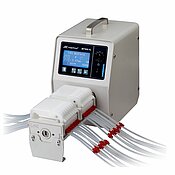
Laboratory Pumps for a Wide Range of Applications and Transfer Tasks
Laboratory pumps are used wherever liquids need to be conveyed or dosed precisely, reproducibly, and safely. Depending on the application, requirements vary in terms of flow rate, accuracy, fluid properties, and area of use. For this reason, laboratory pump portfolios include different pumping principles, each specifically designed for particular applications.
For highly precise dosing tasks in the microliter and milliliter range, syringe pumps are especially suitable, as they provide very fine resolution and accurate volume control. They are commonly used in analytical applications, microfluidics, and medical research. Thanks to constant flow profiles and low pulsation, they are ideal for sensitive processes and continuous experimental setups requiring maximum precision.
Peristaltic (tubing) pumps, on the other hand, offer maximum flexibility in laboratory operation. They enable contamination‑free fluid transfer, as the medium only comes into contact with the tubing. A wide range of pump heads, tubing materials, and flow ranges allows their use for dosing, filling, media transfer, or sample handling in laboratory environments. Even aggressive, abrasive, or biological fluids can be conveyed reliably.
For applications requiring higher flow rates or increased pressure, gear pumps are commonly used. These pumps are characterized by uniform flow delivery and high repeatability. They are preferred whenever constant flow rates and stable process conditions are required, for example in test benches, dosing systems, or continuous laboratory processes.
Regardless of the pump type, modern laboratory pumps offer a wide range of control and interface options. These include speed and flow control, external control, digital interfaces, and easy integration into existing laboratory and automation systems. Robust housings, chemically resistant materials, and low‑maintenance designs ensure reliable continuous operation.
The selection of the appropriate laboratory pump therefore always depends on the application, the medium, the required flow rate, and the desired level of accuracy.